

Opinion by Andrea Thompson
The ongoing refresh of the New Zealand curriculum has once again brought to the foreground the importance of fostering a genuine life-long love of learning in students.
This is not only important for securing academic success, but also for setting up young people to succeed in their lives after they leave school.
This has long been a priority for educators, but as we transition to an increasingly uncertain economic landscape, equipping students with this fascination has never been more important.
Read the latest print edition of School News online HERE.
How teachers can best achieve this is an enduring debate. However, there is a persistent consensus around the importance of self-directed learning.
At OneSchool Global, the global network of schools with 18 campuses in New Zealand, we developed a bespoke framework to achieve just this.
This framework, which is underpinned by technology-rich learning environments, seeks to empower students to take ownership of their learning, develop agency over their studies, and recognise how they can best learn.
This is a unique approach to learning, which has revealed unique lessons about self-directed learning which can support the ambitions of the refreshed curriculum.
A curriculum fit for the future
Teachers are acutely aware of the challenges facing students after they leave school. Recent statistics released by the New Zealand Government highlight that traditional entry-level pathways into the workforce for young people are shrinking due to rapid technological change.
Increasingly, entry‑level positions, often filled by recent school leavers, now expect young people to adapt quickly, operate in complex environments, and continue learning new skills from the outset.
For educators, these shifts carry profound implications.
Related School News article: Curriculum implementation timeline extended for New Zealand schools
It is no coincidence that the curriculum review, including the recent draft Year 0–10 curriculum content, places renewed emphasis on coherent knowledge progression alongside the development of confident, capable learners who understand how learning works.
The draft content signals a clear intention: students must be ready to leave school not only with essential knowledge, but with the skills and dispositions to keep learning throughout their lives.
The Learning to Learn Framework
At OneSchool Global, the Learning to Learn Framework is designed to make the process of learning explicit for students.
Rather than assuming learners will naturally develop effective habits, our framework places key behaviours such as organisation, diligence, reflection, and ownership at the forefront of their learning.
These are intentionally embedded into everyday classroom practice and skills are built intentionally from Years 3 to 13, shaping how learning is structured and how expectations are communicated. As they move through their learning journey, students are then able to develop greater autonomy over their studies.
In addition, students engage with structured content, monitor their progress against clear expectations, and seek targeted support.
This illustrates how technology and explicit teaching of skills can strengthen both knowledge acquisition and learner agency when used in combination.
Five scholarships, one approach
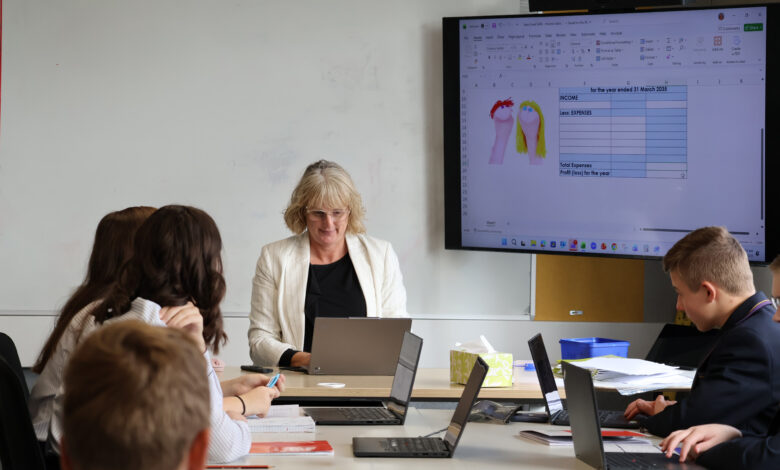
This year, I observed this framework in action with my Year 13 Scholarship Accounting class.
Scholarship Accounting is a demanding programme. In addition to completing internal assessments and preparing for the Level 3 external exam, students take on substantial additional content, including advanced financial statement analysis and higher-level accounting concepts.
The addition content enables students to sit a three-hour exam at the end of the year. This workload quickly exposes the limits of passive learning.
To cope, students must be organised, reflective, and disciplined. They need to set clear goals, monitor their progress, and adapt their strategies when they encounter unfamiliar or complex material.
These skills are taught deliberately. Students are supported to break tasks into manageable steps, set clear goals, and monitor their progress.
Over time, students begin to understand not just what they are learning, but how they are learning.
Five of my students ultimately achieved NZQA Scholarships, a result that speaks to the power of this approach.
Lessons for educators
There are clear takeaways for educators looking to better empower self-directed learners across a range of contexts.
First, there is undeniable value in teaching students to learn how to learn. This is the foundation of our methods.
Skills such as planning, reflection, applying feedback, and goal setting should be embedded into everyday practice. By doing so, students are better equipped to manage increasing complexity as they move through school.
Second, thoughtful learning design matters.
By intentionally aligning classwork, extension tasks, independent study and scholarship level challenges, students are equipped with the full set of tools and conceptual depth to succeed in their studies.
This approach not only builds content knowledge but also reinforces the importance of deliberate practice, preparation, and time investment.
Third, supporting students to become self-directed learners does not mean stepping away. In fact, it often requires more intentional teaching and coaching.
I increasingly saw my role as creating an environment where independence sat alongside strong relational support. Students were encouraged to take responsibility for asking questions, booking tutorials, and reflecting on feedback.
Treating them as young adults capable of managing their learning, while still offering structure and guidance, proved to be a powerful balance.
Finally, my experience challenged the assumption that top academic outcomes are limited to a narrow group of students.
What separated these learners was not perfection, but perseverance.
When knowledge is carefully sequenced and supported by strong learning habits and feedback, a broader range of students can achieve academic success, including at Scholarship level.
Life-ready students
The refreshed curriculum presents an important opportunity to renew our focus on developing both knowledge and capability together – a genuine focus not just on what is to be learned, but on the process of learning itself.
When we equip students with an understanding of how learning works, we prepare them for a future that will continue to demand adaptability, curiosity, and lifelong learning.
 This article was written for School News by Andrea Thompson. Andrea Thompson is the Regional Head of Commerce at OneSchool Global, where she has spent the last 12 years of her 25-year career in education.
In her role, she teaches Accounting and Commerce across OneSchool Global’s campuses in New Zealand. Andrea has guided students to scholarship success every year since joining OneSchool Global, including a Top Scholar in Accounting. She also achieved a Top Scholar result at her previous school.