AI tools for teaching and learning: Embracing technology to enhance workflow
While teachers will always remain the most valuable asset for students, AI tools can have a significant impact on teaching and learning

Artificial Intelligence (AI) has quickly become an embedded part of everyday life.
It’s not surprising, then, that AI tools have been developed for teachers with the aim of streamlining planning, resource creation, assessment and more.
Read the latest print edition of School News online HERE.
A bot for every task
While there are plenty of generic AI chatbots that may suit one-off queries or tasks, bespoke teaching AI tools are built with an education-specific focus for flexibility and ease of use.
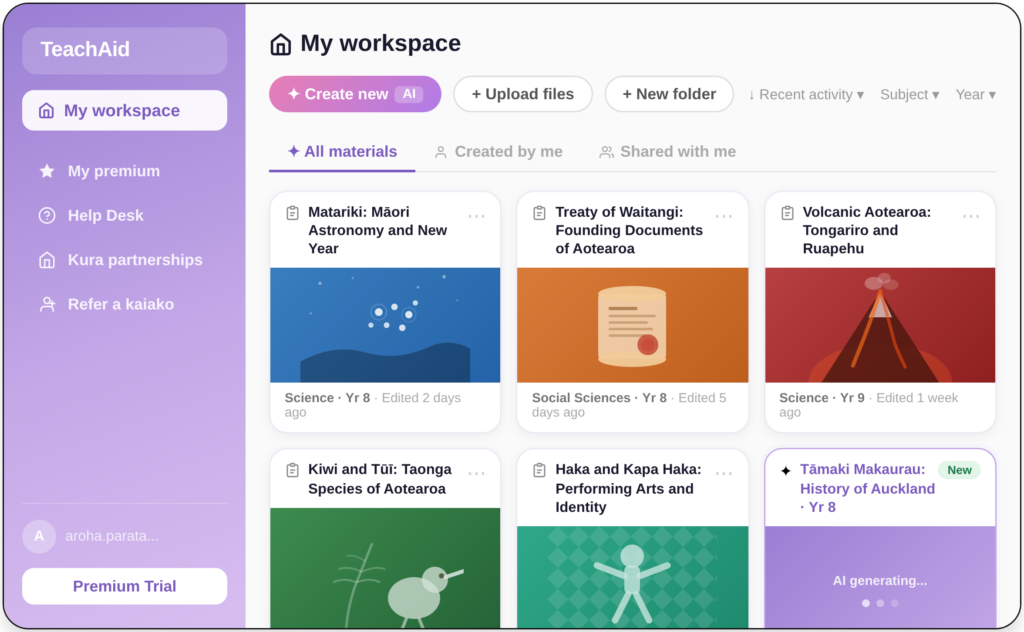
Nadeem Aljaber, founder of TeachAid, said AI can help teachers to streamline their day, without sacrificing outcomes.
“AI can save teachers considerable time on routine tasks, from drafting parent communication to creating worksheets, lesson materials, and simple classroom resources. That matters, especially when workload is already so high.”
“But the bigger opportunity is not just doing those tasks faster. It is using AI to support the deeper work of curriculum and pedagogy, helping teachers build coherent and consistent units and assessments that align to the New Zealand curriculum, reflect local context, and embed culturally responsive practice, including Indigenous education and Māori education,” Mr Aljaber said.
Making the most of AI tools
One of the benefits of using AI teaching tools is that many offer a variety of modular options, meaning educators can choose which elements they want to use. Schools, or individual staff members, may choose to use them only for lesson planning, or make use of the full suite of options.
However, AI tools can work best when used consistently; teachers across the same phase, or teaching the same subjects, can coordinate to ensure that the tools they are using are working efficiently.
AI works best when used holistically, Mr Aljaber said. “AI tools can help with lesson and curriculum planning by doing more than generating isolated activities. They can help create greater alignment and consistency across a school by connecting planning to curriculum expectations, school values, and the broader direction the organisation is trying to move in.”
Related School News story: OpenAI develops ChatGPT for teachers
Working with intention
Likewise, the use and implementation of AI tools should be overseen at the leadership level for optimal alignment and efficiency, to ensure that all staff are making the most of the potential gains in time saving and beyond.
“One of the biggest challenges in education is implementation,” Mr Aljaber said. “Schools invest in professional learning, develop multi-year plans, and set clear strategic priorities, but too often those intentions get lost between leadership direction and day-to-day classroom practice.
“That is where well-chosen AI tools can be useful: helping translate those priorities into actual units, lessons, assessments, and teaching approaches so the work of implementation is more consistent, practical, and visible in classrooms.”
Real time responsiveness
One of the biggest benefits of AI is its potential to synthesise large amounts of information and use it to produce a clear outcome. In education, this has the potential to offer extremely personalised learning pathways.
Danny Bedingfield, AI Specialist at Brightstar said a major advantage of AI tools in the classroom is the ability to personalise learning at a scale in ways that were not possible before.
“In a primary or secondary classroom, generative AI can help tailor content, pace, and support to each learner. The same learning goal can be presented at different reading levels, with varied examples, alternative explanations, or scaffolded steps.
“Importantly, this aligns strongly with Universal Design for Learning. AI can offer multiple means of representation, action, expression, and engagement. For example, content can be converted into text, visuals, summaries, quizzes, or discussion prompts.
“Learners can demonstrate understanding in different ways, and learning assistants can adapt materials quickly for neurodiverse learners, English language learners, or students with additional needs.
“The real power is that educators remain in control,” Mr Bedingfield said. “AI does not replace professional judgement, but acts as a responsive assistant that helps adjust and personalise learning in real time.
“Used well, it frees teachers and learning assistants to spend more time building relationships and supporting learners where it matters most, while ensuring every student has access to learning that meets them where they are.”
Fostering collaboration and engagement
Teachers are always seeking ways to increase student engagement, but what sparks interest for one student may not work for another. Different AI tools can produce a range of engaging resources, from slideshows to worksheets, polls, quizzes and even interactive games that appeal to a wide range of learners.
AI powered technology can enhance classroom interaction but should be used selectively for maximum impact, said Mr Bedingfield.
“In practice, some students respond very positively to generative AI. One on one or small group use can be powerful, particularly when AI is positioned as a tutor rather than an authority.
“For example, AI can generate practice questions, explain concepts in different ways, or provide initial feedback on draft work.
“However, not all students engage well with generative AI. Some prefer human interaction, peer discussion, or hands on learning,” Mr Bedingfield said. “This means AI should be an option, not a requirement, and part of a wider toolkit rather than the centre of the lesson.
“Teacher oversight is critical. Generative AI can hallucinate and produce incorrect or misleading information, so it cannot be trusted as a sole source of truth. The value comes not from the technology itself, but from how thoughtfully it is integrated into good teaching practice.”
No substitute for teachers
AI tools should be treated as a way to supplement the expertise of teachers, not to replace it.
Mr Aljaber advised that schools should select AI tools that are human-centered in their design.
“Schools should look for AI tools that are teacher-facing, not tools that try to replace teachers or work directly with students without strong oversight. A responsible tool should keep educators in the loop so they are reviewing, shaping, and approving what is used in the classroom.”
Mr Aljaber said, “They should also look for whether the tool can reflect the school’s actual context, including curriculum, local priorities, school values, pedagogical frameworks, and culturally responsive and Indigenous education commitments. Otherwise, the output is often generic.
“Choose tools that are built around a human-centred loop, helping teachers turn school priorities into classroom planning and practice, rather than putting AI directly in front of students.”
Ensuring AI tools are developed and used responsibly is one of the hardest challenges schools face, said Mr Bedingfield.
“Responsible adoption means avoiding the wide range of free AI tools that require student accounts, scrape content, or have unclear data practices. Even well‑intentioned use can result in student data or intellectual property being shared in ways schools did not intend.
“Finally, governance matters as much as the tool itself. Schools should have clear policies, staff training, and agreed expectations around how AI can and cannot be used. Educators must remain in control, critically evaluate outputs, and teach students to do the same.”
Happy teachers, happy classrooms
Given their wide range of features, AI tools for educators can have a real impact on how teachers use their precious time. While there’s no substitute for a compassionate, knowledgeable and engaging professional at the head of the class, the right tools can help with work-life balance, help teachers explore new ideas and provide personalised learning that can lead to a happier classroom environment.