
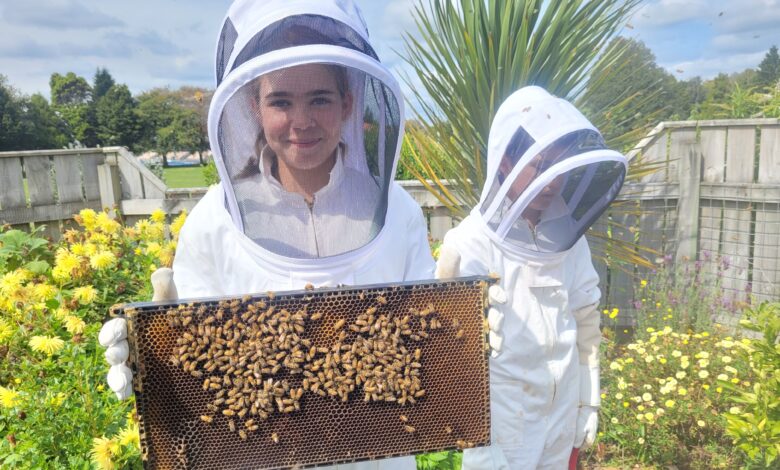
Picture a school with beehives, orchards and a chicken coop, where students spearhead their own seed selling initiatives and make firebricks with wastepaper.
It might bring to mind an ultra-rural Kiwi idyll, perhaps even from a bygone era.
Read the latest print edition of School News online HERE.
But that school is very real, and it’s not a tiny one-room schoolhouse surrounded by rolling farmland. It’s Stratford Primary School, just around the corner from the town’s CBD, with a roll of over 450 ākonga and growing.
It’s this unusual set up that caught the eye of the Blake Awards, with the school winning the 2025 Schools Blake Leader Award. The accolade acknowledges Stratford’s extensive environmental measures, which are woven into the school, its grounds, and its curriculum.
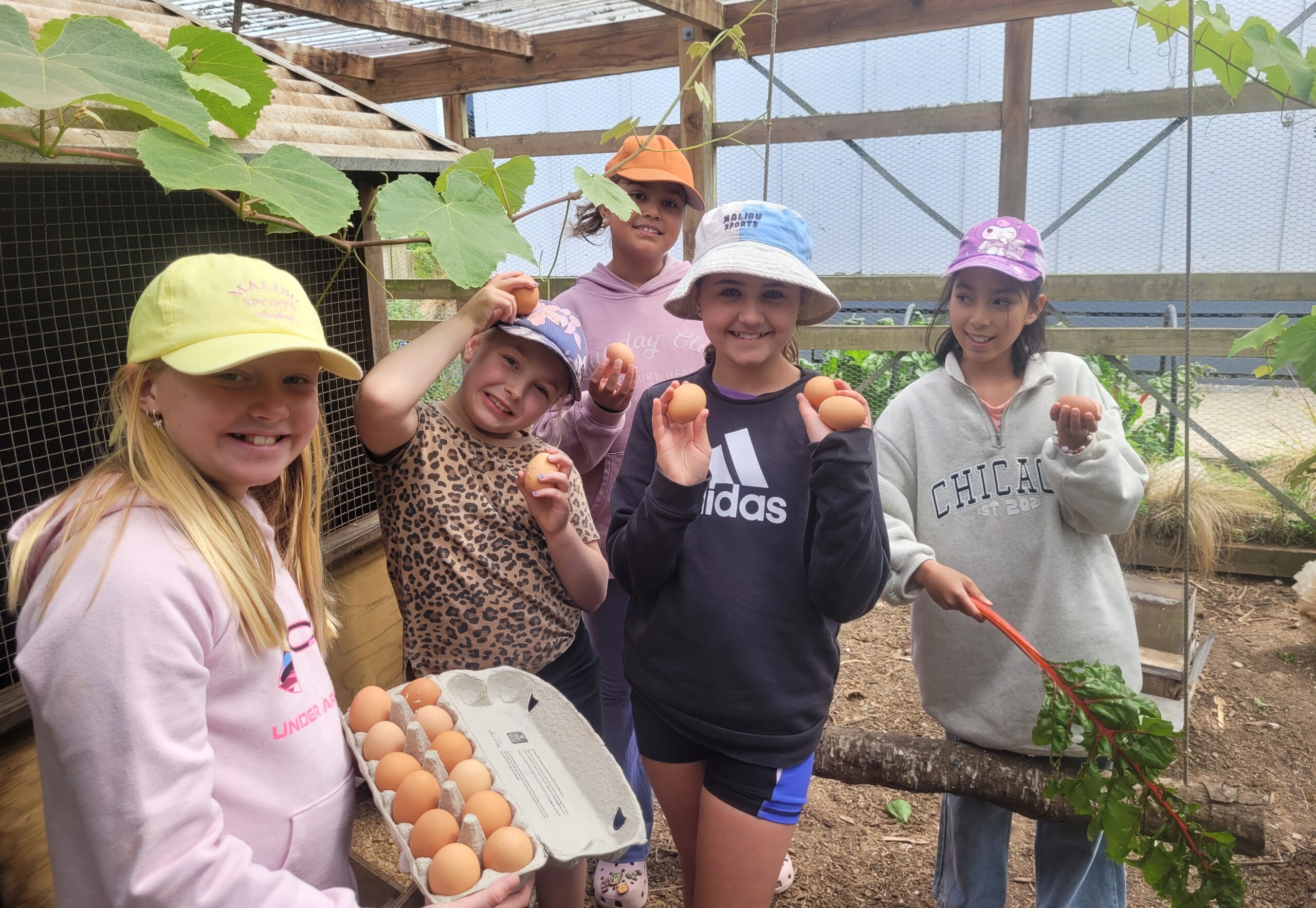
Stratford has been a Green-Gold Enviroschool since 2022, the highest tier of the national schools’ environment scheme, thanks to its many eco-elements. These include vegetable gardens, composting and recycling systems, and even a chicken coop, aptly named the Heihei Hotel.
One of the more unusual features is the school’s apiary. Here, the students harvest honey and monitor the health of the hives, all in protective bee suits, of course. It’s a favourite with the students, thanks in part to the constant supply of fresh honey. The hives also provide invaluable learning opportunities, from life cycles to pollinators and the importance of even the smallest parts of an ecosystem.
Living life through a green lens
What makes Stratford Primary School exceptional is that it’s clear their Enviroschools programme isn’t an add-on to their traditional curriculum learning; it’s a crucial part of it, woven throughout the school day, week and year.
As Enviro Coordinator Marlene Lewis, the driving force behind the school’s sustainability initiatives, sums it up:
“We live our life through a green lens. Everything we do, we ask ourselves, is that good for the environment? Is that going to be long term, sustainable?”
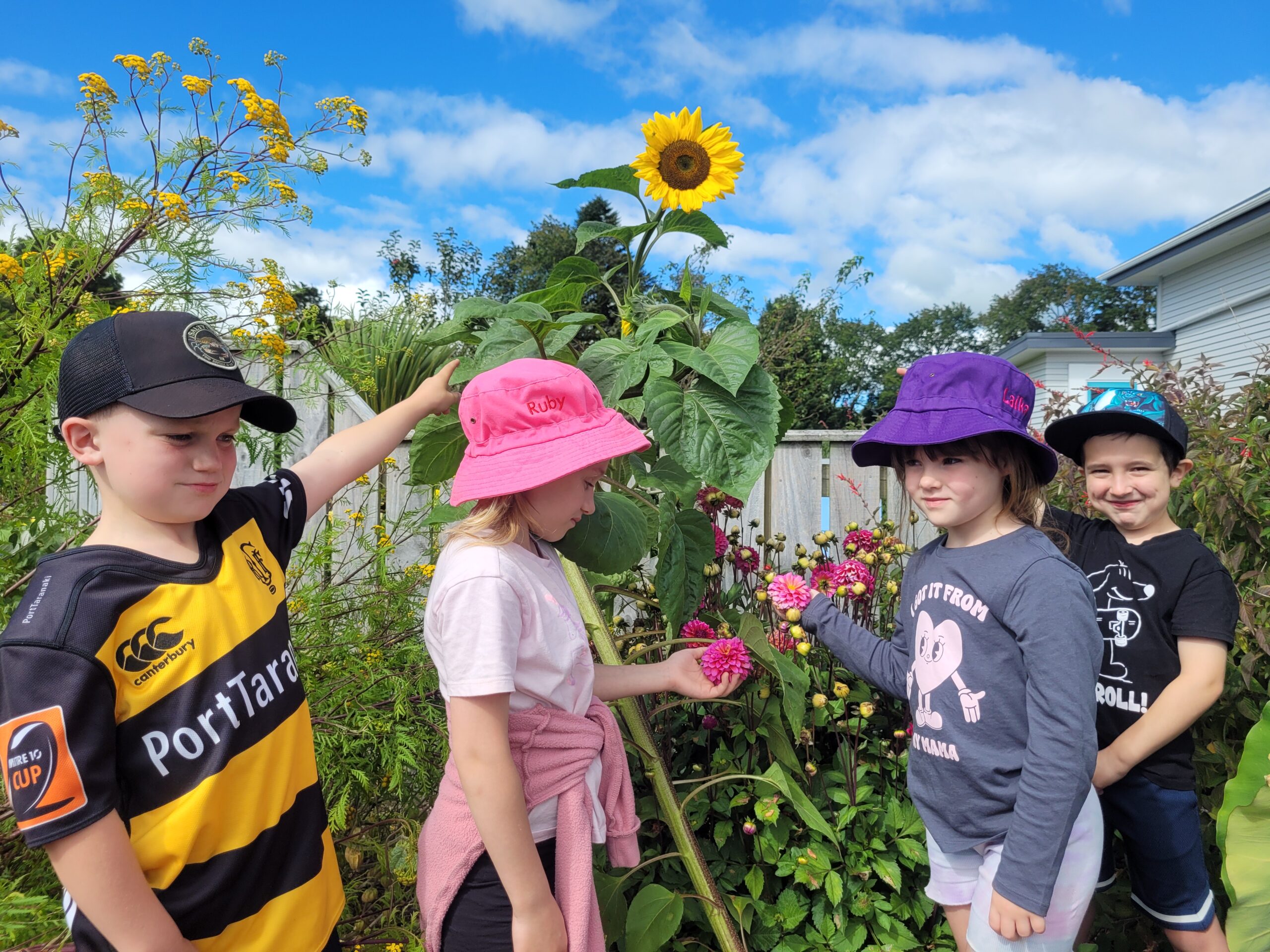
Take the school’s sunflower garden. It naturally provides opportunities to learn about the life cycles of plants and the conditions they need to grow.
Beyond that, though, the students use the seeds in their maths lessons, counting them to bag them up, then using money skills, selling seeds to the community and raising funds for the school. That idea came from a student who noticed how many seeds each sunflower head contained.
Student-centered learning
That student-led learning approach wasn’t a one-off; each classroom has a large amount of agency over their learning.
Students’ curiosities and ideas are heard and woven into the classroom’s learning, said Ms Lewis.
Read more school profiles HERE.
“We had a huge Matariki day for the juniors; the idea came from one classroom. They grew a plot of vegetables, and all their vegetables were used to make vegetable soup for our school whanau to enjoy.”
In another classroom, a student realised that small scraps of paper weren’t recyclable, and so their classroom has been making offcuts into fire starter bricks to be sold in the winter.
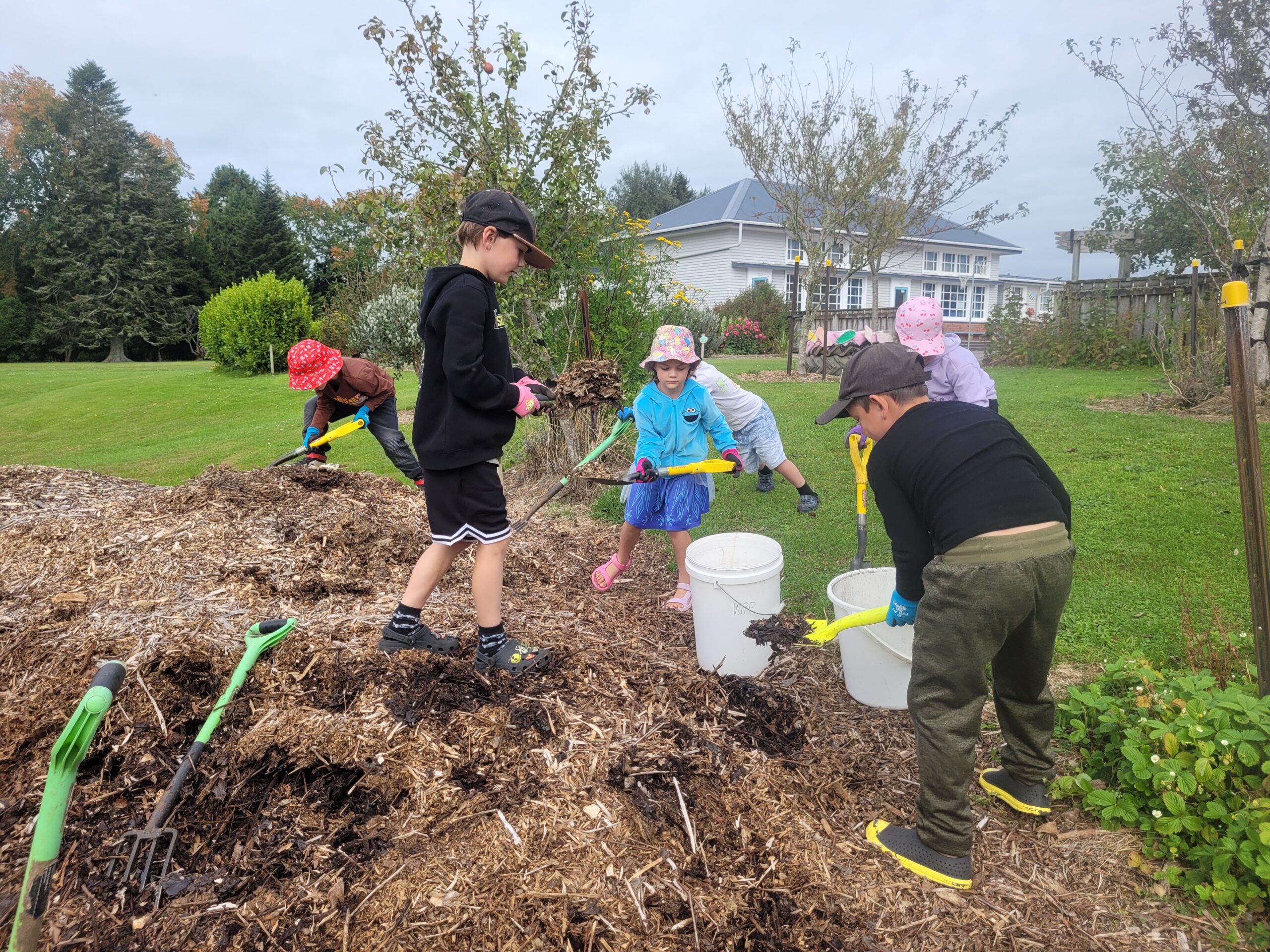
Keeping the scheme going is largely the students’ responsibility; they manage their own rubbish, recycling and composting, and most classes tend their own flower and vegetable gardens on the school grounds.
Ms Lewis explains: “Each class has their own responsibility. They’re responsible for the waste they’ve created, and we’ve got systems for them to go and empty their food scraps, etcetera.”
The result is confident, self-sufficient learners who know the environmental systems well because they work with them every day.
Leaders of tomorrow
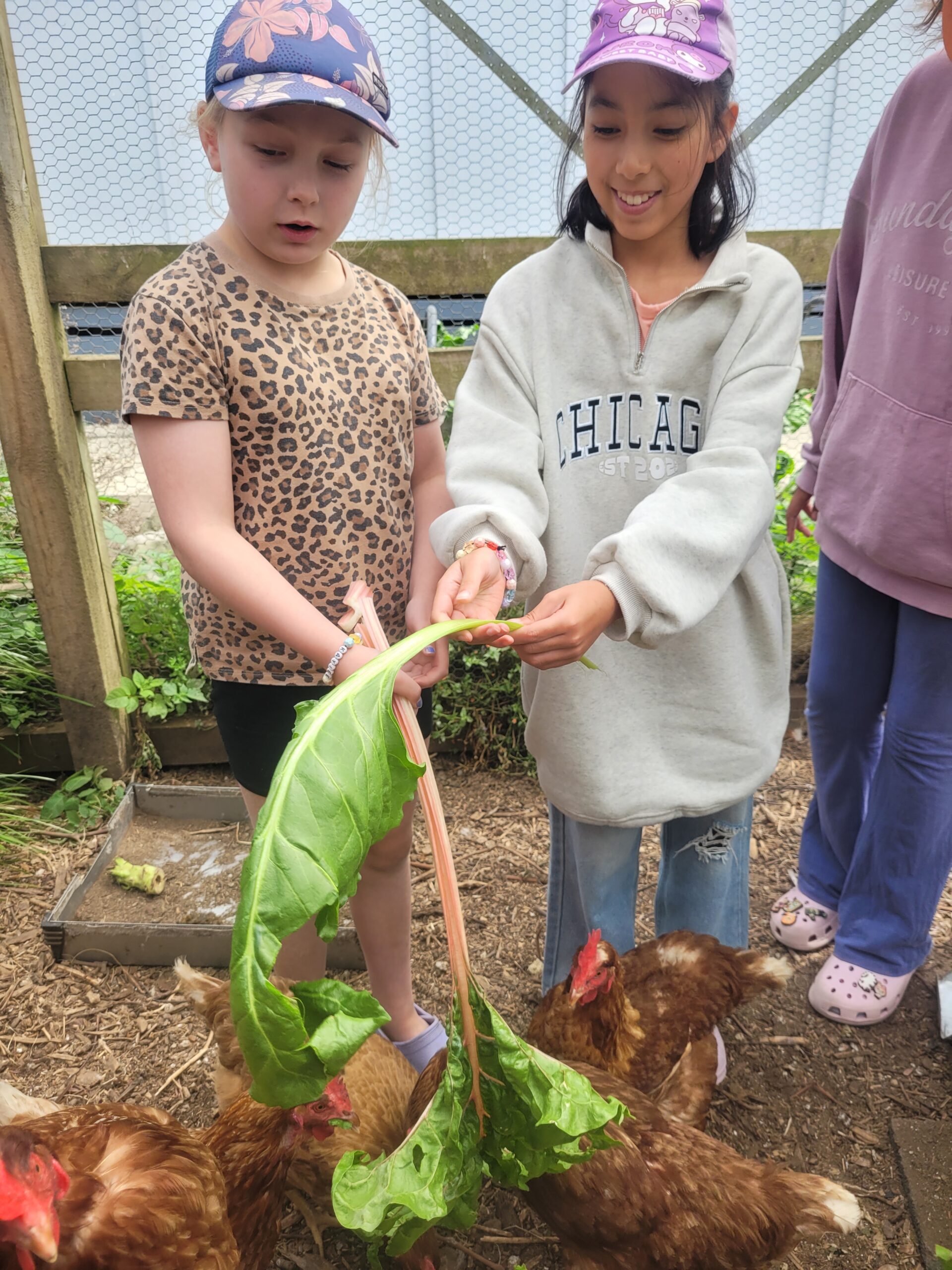
At the heart of the scheme are the student leaders; two are selected each year to help and inspire their fellow ākonga, so they know the programme like the back of their hand.
Stratford’s 2025 Tūī Enviro Leaders, Elliotte and Neriah-Joy, confidently rattled off to School News the list of environmental measures that form part of the school’s everyday kaupapa; the recycling and rubbish systems, composting, classroom plants and outdoor garden areas, greenhouse, beehives (“the beehive’s my favourite,” Elliotte confirms), the chickens.
The Enviro Leaders are elected each year; Neriah-Joy has taken on the job again for 2026 along with new leader Anna. Elliotte has moved on to secondary school.
The student leaders have an additional responsibility in the form of a weekly assembly on Fridays, as Elliotte explained.
“We have our school assembly every Friday and Neriah and I as Enviro Leaders go up every week and announce the Enviro Award, which is basically an award that goes to a class that has done best Enviro for that week.
“If you’ve passed your recycling test, if you’ve got all 100 percent, we will check your class and make sure it’s tidy. We also talk about what we’ve done good and what we need to improve on.”
It’s clear that the student leaders understand the importance of the environment on their fellow ākonga. Of the school and its grounds, Elliotte shares:
“It means everything. It’s just a place for kids to feel at home, and it helps them with stress, being outside and helps kids focus when they can’t think.”
The wider significance of their actions isn’t lost on them, either, as Neriah explains. “I guess if we don’t look after (the Earth), we won’t get a very long time out of it, but you can expand it by being kaitiaki to it. There is no Plan B, there is no other earth to go to, so we need a take care of the one we have right now.
“Sometimes as a kid, you don’t think you can make a big impact, but if you actually try hard enough you can. And if everybody does a little bit it can make a big impact.”
A passionate advocate
While the success of the scheme depends on students’ enthusiasm and participation, it would never have been possible without the tireless efforts of adults behind the scenes, particularly those of Marlene Lewis.
Ms Lewis took on the environmental coordinator role in 2013, and the school has never looked back. Among the many initiatives she’s implemented to inspire the next generation was introducing the beehives, a personal passion of hers.
“Probably the enjoyment I get most out of it is actually working with the tamariki, empowering them and seeing where they want to take their learning. There are learning opportunities all the time.
“Still to this day I look at the students faces when I open the lid of a beehive and see amazement—it still gives me a little bit of a shiver.”
It’s obvious that Ms Lewis cares deeply about the school and its students.
“It comes down to our school values; to be the best we can be and showing manaakitanga to our environment is really important to us. We’re presenting our environment to closely link with our school values.
“It’s our expectations. It’s who we are.”
Support from the top
Principal Jason Elder laughs as he admits: “I call Marlene ‘the boss’.”
When Mr Elder became principal at Stratford Primary in 2016, the journey was already underway, he said, thanks to Ms Lewis’ efforts. Recognising the importance and potential of the scheme for the school and its students, he was on board from day one.
His reasoning was simple: “I could see how this could really engage the kids.”
His instinct was correct; he cites a shift in overall school culture and attributes it in no small part to their environmental approach.
“Our culture now compared to from then is significantly different.
“We’ve got a survey going at the moment, and one of the questions that I asked parents is ‘How safe do you feel the school is out of five?’. At the moment, it’s rated 4.5 out of five.
“That’s been consistent over the last few years, and it shows too the importance, that the environment we’ve created is a big part of it.”
Those whole-school improvements begin with valuing every student as a part of the school and its environment, he said.
“A lot of our kids don’t have these experiences before they get to school. And so we’ve created an environment—and we’re still working on it—with that real sense of belonging. But the environment is so good in terms of engaging them, nurturing them.”
“The kids are the future citizens, they’re the ones who are going to make decisions around the future, around the environment. And if they can love it, nurture it, support it, our society’s going to be so much better.”
Award-winning but not complacent
Stratford Primary School’s win at the 2025 Blake Awards allowed the staff and students to show off their hard work at an awards ceremony in Hamilton. The student leaders, Elliotte and Neriah-Joy were there to accept the accolade.
Neriah-Joy said: “It was really cool when they announced us, and then you just get like this ‘Ohh it’s really happening’ [feeling].” Seeing the video that was played to showcase the school’s work to the audience “was pretty exciting”.
“I guess what it means to me is that we’ve worked hard and it’s actually shown off and been acknowledged.”
Ms Lewis said it was special to receive the award.
“We’re pretty humbled but very proud of what we’ve been recognised for doing. That’s really quite emotional for us, it really took us away.”
“I took it as recognition of a long standing and deeply embedded commitment to environmental education and sustainability across all of our school life. This has been a huge commitment for many years for us, so to be acknowledged for our mahi really creates a sense of ‘Hey, we’re doing some good here, we’re in the right direction’.”
Mr Elder said it was a great waypoint, but not the end of the journey for the school. There is plenty to be learned from what others were doing well, he said.
“We’re always trying to improve. We went to an amazing school, Manurewa Intermediate, and we saw how we could extend what we’ve started through some ideas.”
In the meantime, though, the school whānau is proud of the environment they’ve created, said Ms Lewis.
“When students and their families step onto our kura, our aim is to create that feeling of a sense of pride, a belonging to our place; utilising our environment for the benefits of all peoples.”
“It means a lot to us.”