Fostering wellbeing: Practical strategies for supporting students and staff
Poor mental health in students is linked with poorer school performance, increased aggression & bullying; we explore strategies to combat this.

Wellbeing: whether the word conjures yoga practice, nature walks or quiet reading time, it’s a topic that is gaining traction globally.
However wellbeing looks for each individual, research is increasingly showing its benefits, especially in young people; poor mental health in students is directly linked with poorer school performance and increased aggression and bullying.
Read the latest print edition of School News online HERE
Schools are well-placed to help young people navigate and take ownership of their wellbeing, but this is a potentially daunting task on top of school staff workloads. Luckily, there is more support than ever to help schools improve wellbeing for students, staff and teachers.
Choosing effective strategies
Perhaps unsurprisingly, a study from the New Zealand Council for Educational Research (NZCER) found that schools with policies, practices and dedicated teaching time centred around wellbeing had higher student wellbeing than those without. Among the most successful interventions was teaching students strategies for managing their emotions.
There are many ways to build this into the school day, including partner and group talk sessions, as well as encouraging students to take some deep breaths and put words to how they are feeling. For younger learners, classroom displays with key emotion words can be helpful, whereas a more complex emotions wheel would make a great secondary classroom resource.
Tools and programmes for wellbeing
Another increasingly popular option is the use of wellbeing programmes and toolkits. These often have the advantage of being developed by experts in the field, and some are backed or used by organisations such as the Ministry of Education, NZCER and Health New Zealand.
An additional advantage of using pre-existing programmes is the decreased time spent on research and planning for teachers. The time saved could be spent fostering staff wellbeing. Unicef suggests teachers build wellbeing into their routines with simple steps such as spending one minute taking deep breaths as soon as students have left for the day.
Related School News article: Five ways to find better work-life balance this school year
Adopting a mindful approach
This short break approach can be useful in the classroom, too. Wellbeing practices can be quick, such as a few minutes of box breathing before transition times, or short movement breaks with a variety of stretches.
If there is more time available in the school day, then yoga routines, sharing a story about feelings in a primary classroom or a session on sensory grounding techniques in a secondary setting are good options.
As with any practice, the key is consistency. Giving students the opportunity to try a range of methods to boost their wellbeing will help them to develop a toolkit that works for them.
Building positive peer relationships and behaviours
As well as encouraging students to look inwards, it’s important to build positive relationships between peers. Maintaining friendships and peer networks can be crucial to young people’s mental health.
A 2023 study by the Ministry of Education found that, when asked about wellbeing, secondary students reported that bullying and friendships were among their biggest concerns. That’s hardly surprising, given that students spend their weeks surrounded by their peers.
The Ministry of Education’s Inclusive Education initiative suggests buddy systems, along with promoting group and team work on a classroom and year group level can help empower students to build positive relationships.
Assessing wellbeing
A final consideration is how to measure improvement. Although wellbeing is hard to quantify, there are ways to gain insights from students. Direct feedback is perhaps the most important of these; students can always give the best insights into their own feelings.
How this feedback is gathered will depend on the contexts and age groups involved, but all students should feel that their thoughts are valued and impactful. Consider how the school’s approach will be informed by student feedback and make them aware of this; this will further help to develop students’ sense of ownership over their wellbeing.
Related School News article: Leaving the classroom to boost wellbeing
Some organisations shared with us how they can help schools to plan and implement effective wellbeing strategies
Many schools across Aotearoa are using Pause Breathe Smile, a free mindfulness programme designed specifically for education settings, to support a calm and settled start. The programme provides a shared language and simple, practical strategies to support mind health for both kaiako and ākonga.
The beginning of a new school year brings fresh energy alongside familiar challenges. New students, routines, and expectations arrive all at once, often accompanied by big emotions and a need to rebuild a sense of safety and belonging. How teachers shape these first weeks plays a key role in setting classroom culture for the entire year.
Pause Breathe Smile is not about requiring silence or expecting perfect focus. Instead, it supports tamariki to notice what is happening in their bodies, thoughts, and emotions, and then practise ways to self-regulate and refocus. These vital mind health skills can support smoother transitions, reduce reactivity, and normalise conversations about feelings and hauora (wellbeing).
The approach is designed to fit easily into the school day. Short breathing practices, mindful movement, and shared language can be introduced early, before beginning the structured hauora lesson content.
Over time, these small, consistent practices help create calmer classrooms where students feel supported to learn, and teachers are equipped with practical tools to support wellbeing throughout the school year.

Tātai Aho Rau Core Education provides professional development through Te Poipoi Kaiako | Mentor Support Programme. The programme is fully funded by the Ministry of Education for kura, schools, and early learning services. The programme includes videos, modules, workbooks, guidebooks, and templates to help develop a supportive, inclusive, responsive, and growth-focussed mentoring relationship.
Waiora | wellbeing is a foundational kaupapa in the programme, recognising that it contributes to quality teaching and job satisfaction.
Teaching is demanding. It can be overwhelming and rewarding in equal measure. Recognising stressors, triggers, needs, and achievements is a teaching super-power. Finding the fit that works requires guidance and practice. Regular, intentional actions contribute to long-term benefits.
Te Poipoi Kaiako explores a number of strategies and tools for Mentor Teachers to support the wellbeing of their mentees including wellbeing check-ins, breathing techniques, peer support networks, strength spotting, intentional listening, and using feedback that increases confidence and motivation.
Te Rōpū Rongomau o Aotearoa has spent 50 years working alongside kaiako and ākonga to deliver peer mediation programmes to kura throughout New Zealand.
With facilitators based across the North and South Islands, The Peace Foundation delivers two core programmes for primary and secondary schools.
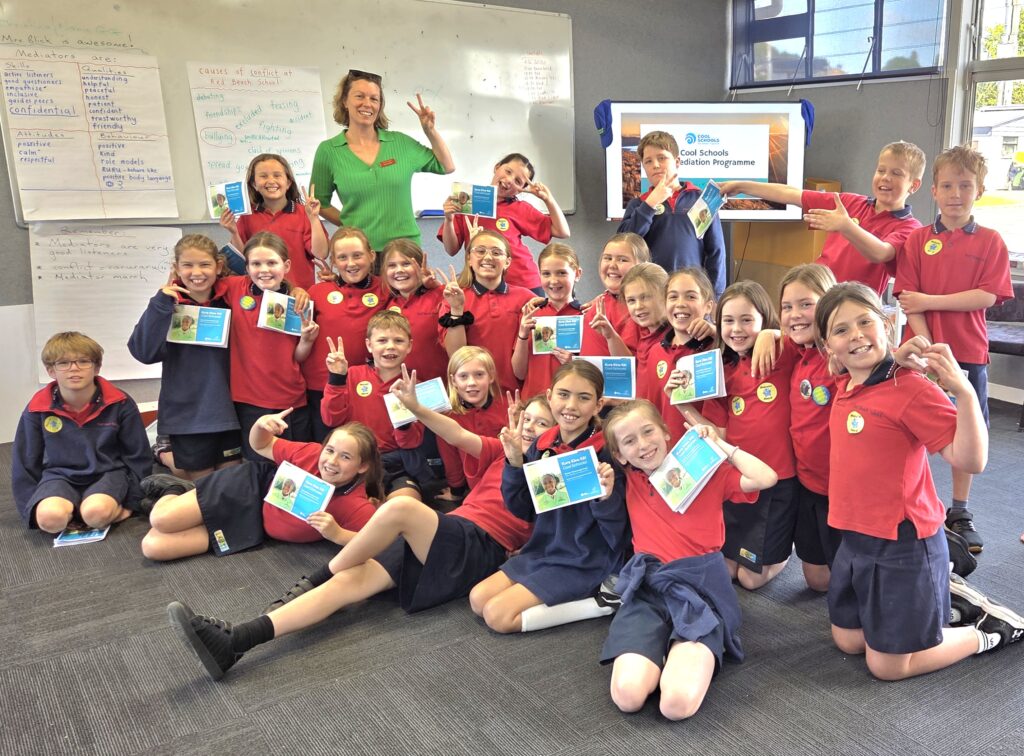
The Cool Schools Peer Mediation Programme supports primary kura by training kaiako to feel confident in teaching classroom conflict resolution skills and supporting the implementation of a student-led peer mediation service.
The secondary Leadership through Peer Mediation (LtPM) programme empowers rangatahi to lead mediation. Both programmes teach essential life skills, such as empathy and respectful communication to empower their peers to deal with conflict constructively.
Training is flexible and responsive to each school’s needs. Additionally, Peace Foundation membership provides access to relevant and culturally appropriate support resources. By creating safer school environments, ākonga feel more connected and confident, leading to more positive learning engagement. With more respectful communication, kaiako and ākonga are able to focus on learning.
Peace Foundation welcomes all enquiries from tumuaki/school leaders so that they may understand your context and explore together how their programs might support your school culture to thrive. Tamariki and rangatahi want to be at school when they feel safe and know they have the skills to engage with others successfully.
Barnardos Aotearoa collaborates with schools to support the wellbeing of rangatahi, staff, and the wider school community in various ways. Barnardos’ What’s Up helpline plays a key role in providing tamariki and rangatahi with confidential, accessible support, allowing them to reach out for counselling support when they are facing challenges. Barnardos works closely with schools to ensure that students are aware of this service and feel encouraged to use it.
Barnardos also collaborates with the Life Education Trust’s programme and OfficeMax to raise awareness of What’s Up within the school community. These partnerships help spread the message to students and staff, and wider whānau, ensuring that they have the information they need to access support when they need it.
By embedding these services and resources within schools, Barnardos aims to create a supportive, open environment where students feel safe seeking help. Schools can also refer students to Barnardos’ community and social services, providing full wraparound support that addresses mental health, wellbeing, and the wider challenges young people may face.