
Education and Training Amendment Bill progressing through parliament
The controversial Education and Training (System Reform) Amendment Bill had its first reading in Parliament.

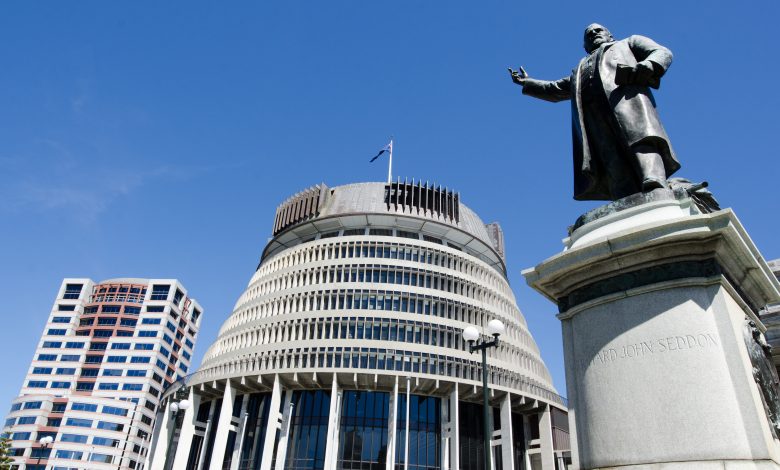
Last week the Education and Training (System Reform) Amendment Bill (the bill) had its first reading in Parliament and will be moved through under urgency.
“It is crucial that New Zealand has a world-leading education system that encourages every young person to reach their full potential, and the bill introduces a set of fundamental, system-level changes that strengthen the structure and accountability of our education system,” said Minister for Education, Erica Stanford as she introduced the bill.
Read the latest print edition of School News online HERE.
The bill has been controversial for its proposals, including mandating changes to the board of the Teaching Council of Aotearoa New Zealand, widely characterised as a political takeover of the profession by the Ministry of Education.
Related School News story: Principals under pressure: widespread opposition to sector changes – SchoolNews – New Zealand
Stanford said that evidence gathered from students showed that initial teacher education (ITE) was not fit for purpose, therefore the Ministry of Education should take over some functions.
“This includes responsibility for establishing and maintaining the standards and criteria for teacher registration, initial teacher education, ongoing practise and the code of conduct.”
Stanford said that the Teaching Council would be given legislative powers over quality assurance, and would continue with its registration, certification, competence and conduct functions.
Other proposals include:
- Establishing the New Zealand School Property Agency, which would be responsible for the school property portfolio;
- Transferring functions for private and hostel schools from the Ministry of Education to the Education Review Office (ERO);
- Strengthening the system response for schools of “serious concern” as identified by ERO;
- Strengthening curriculum settings by requiring regular review and update of the curriculum, and removing the requirement for school to consult with communities on the Health curriculum.
- Updating attendance exemption provisions with specific, national requirements for evidence and duration.
- Enabling the Minister of Education to make participation in system monitoring studies like PISA compulsory;
- Enabling New Zealand Qualifications Authority (NZQA) to include micro-credentials in reporting requirements;
- Supporting the next stage of the charter school model through allowing multischool contracts and a pathway for converted charter schools to revert to State school status.
Educators and sector dissatisfied
The Education and Training (System Reform) ammendment has received huge pushback so far from the education community, and from political leaders in opposition.
Related School News article: Removing Treaty responsibility from school boards undoes decades of progress – SchoolNews – New Zealand
Labour’s education spokesperson Jan Tinetti said “we’ve had some terrible bills in the education space in recent times, and yet here we have another one.
“This bill is yet another ideological attack on teachers and the education system as a whole. It undermines the independence of the teaching profession… I want to actually start right now by saying a future Labour Government will repeal this bill.”
Tinetti said that the bill would enable teaching standards to “become political instruments” at the whim of the current governments.
Related School News article: Teaching Council set to be stripped of powers – SchoolNews – New Zealand
Green party education spokesperson Dr Lawrence Xu-Nan called the bill “sheer arrogance”. Xu-Nan also pointed out that the School Properties Agency would be given the power to authorise changes, but that schools’ operation budgets were not being boosted in kind.
Newly elected Te Pāti Māori representative Oriini Kaipara said the bill would be consequential for Māori futures.
“It claims to strengthen education, but for Māori, it strengthens the barriers… Māori become the target and not the priority.”
Kaipara said property access is a big barrier for Māori early learning, and the property authority represented another barrier.
In an opinion piece / analysis written for the Aotearoa Educators’ Collective, Albany Senior Principal Claire Amos said the curriculum settings represented opening the door to “tiered schooling and the quiet erosion of equity…
“This is not partnership. This is not co-design. This is not aligned with Te Tiriti. This is centralised prescription dressed up as efficiency.”
The bill passed its first reading with 68 “ayes” and is now being evaluated by the Education and Workforce Committee.